


Aoun on amnesty law: Political pressures don't affect me
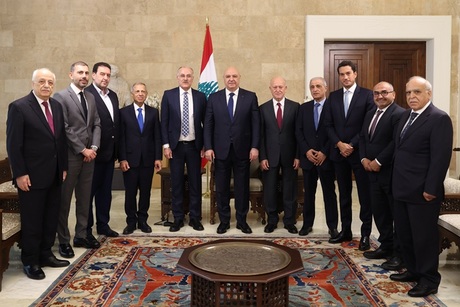
A delegation from the “Sunni MPs bloc” visited President Joseph Aoun on Wednesday to discuss with him the issue of the suspended amnesty law.
“The law reducing sentences does not apply to criminals and a balance must be struck between justice and the public interest,” Aoun told the delegation.
“Terrorism has neither sect nor religion. My priority is the public interest, and I am not affected by media sensationalism or political pressures,” the president said.
Speaking on behalf of the delegation, MP Bilal Abdallah said: “We came to thank President Aoun for signing the law reducing sentences -- a move reflecting a national and humanitarian stance toward thousands of prisoners and detainees who have not yet been sentenced.”
“Those who object have the right to challenge the law, and we defer to the judiciary and constitutional institutions,” Abdallah added.
“No one can pit the army against any component of Lebanese society. This is our Army, and we deeply value its personnel and its martyrs,” Abdallah said.
Lebanon's parliament last month passed the sweeping amnesty law, the first since 1991 after the country's civil war. The legislation is meant to help thousands of prisoners and wanted people, many of them Islamists.
But the Free Patriotic Movement-led Strong Lebanon bloc lodged an appeal with Lebanon's Constitutional Council seeking to overturn the law, leading to a suspension of its implementation on September 10.
Hundreds of inmates at Lebanon's central Roumieh Prison have been on hunger strike for 10 days over the stalled implementation of the law, a judicial official told AFP on Tuesday.
The Constitutional Council, which verifies whether laws are in line with the Lebanese constitution, is expected to announce its decision next month.
For years, Lebanon's parliament had been trying to pass the amnesty law, largely as a way to reduce overcrowding in prisons, which has been exacerbated by slow-moving trials and the detention of suspects for years without judicial proceedings.
In a report last year, the country's National Human Rights Commission said the prison population had reached 300 percent of capacity, with more than 6,200 inmates by the end of March.
Some Islamist detainees have been held for years, in some cases without trial.
The prospect of granting amnesty to some of these detainees, accused of carrying out bombings and attacks against the Lebanese Army, polarized the debate around the law before it was passed.
The legislation, which experts say was the result of political horse-trading, is supposed to also benefit other factions and religious communities.


