


Hong Kong unveils its first 5-year plan that broadens city's identity beyond finance
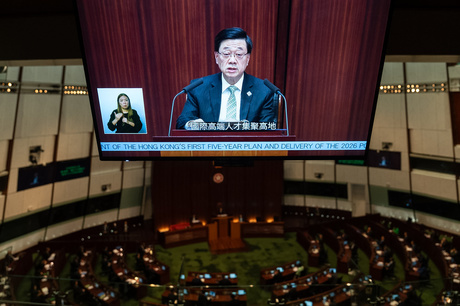
Hong Kong's leader on Wednesday unveiled the city's first five-year plan in a politically symbolic step that echoes Beijing's approach to development, pushing to broaden Hong Kong's identity beyond international finance to also encompass technology and higher education.
In a speech to the legislature, Chief Executive John Lee said the plan's goals include breakthroughs in economic development and enhanced competitiveness, as well as improving people's livelihoods and well-being.
The special administrative region has long prided itself on minimal government intervention in the economy, even as officials have increasingly referenced Beijing's vision for the city. Mainland China in March approved its 15th five-year plan for 2026 to 2030.
Ahead of launching Hong Kong's plan, the city government said it would serve as a framework outlining the financial hub's strategic priorities and not a planned economy, insisting the capitalist system would be upheld.
Lee told reporters later that he's confident incomes would improve for everyone in five years, and that the city would have better education and diversified industries.
"We will be a Hong Kong that is highly empowered by technology," he said.
A major project is underway near the border with mainland China
Another main goal of Hong Kong's plan is to speed up development of the Northern Metropolis, a government project that will provide land for the innovation and technology industry, and build university towns near the Chinese tech hub of Shenzhen. The proposal, first floated in 2021 by Lee's predecessor Carrie Lam, aims to provide 650,000 jobs and house 2.5 million people.
Under the five-year plan, the government hopes to boost the ratio of domestic expenditure on innovation activities to gross domestic product from 1.63% in 2024 to 3% after 2030.
The plan also includes integrating the city's industry development with some academic sectors. Three university towns are planned within the Northern Metropolis, each with its own unique positioning, including one focused on areas such as artificial intelligence and robotics.
To help improve the average living space per person in Hong Kong, officials have proposed raising the size requirements for private home units in the Northern Metropolis.
The government seeks to speed up Hong Kong's development as an innovation and technology hub and also enhance its position as a center for international finance, maritime, trade and aviation.
The city government also proposes to strengthen its role as the world's largest offshore hub for renminbi, mainland China's currency, including by exploring the use of renminbi to settle government expenditures where appropriate.
After returning to Chinese rule in 1997, the former British colony already became more closely linked to mainland China through economic and cultural ties, as well as border checkpoints and transport infrastructure.
Hong Kong's leader will finish his current term next year
In his policy address, Lee has stepped up efforts to boost birth rates. He has planned to extend for three years the measure that offers a cash allowance of 20,000 Hong Kong dollars (about $2,550) for each newborn and increased the amount to 30,000 Hong Kong dollars (about $3,800) for the second or subsequent child.
His administration and the business sector would launch a program to facilitate youth employment.
Observers are watching whether Lee will use the five-year plan and his latest policy proposals to build momentum for a second term next year.
The former security chief fulfilled Beijing's long-standing imperative to enact a homegrown national security law in 2024. Officials said the law and a China-imposed security law were necessary for the city's stability following massive anti-government protests in 2019.
Lee has been under pressure to distinguish Hong Kong from regional rivals and mainland Chinese metropolises, especially after Beijing's tightening grip tainted Hong Kong's image as a freewheeling financial center.
Gary Ng, a senior economist at Natixis Corporate and Investment Banking, said that while the policy direction has not changed much from the past, the government has become more involved in steering the economy with numerical targets and delivery deadlines.
"Technology and education could drive breakthroughs, supported by government debt and more favorable policies, but the rest will still be challenging," he said.


