


Army moves to north Litani after completing first phase of Hezbollah disarmament
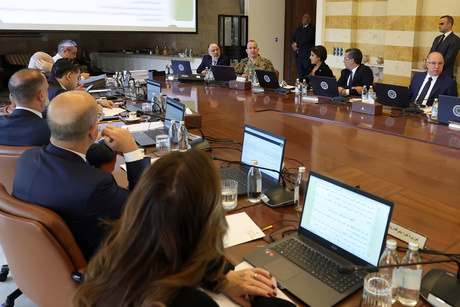
The Lebanese army will present in February an evaluation of the second phase of a plan to disarm Hezbollah in its monthly report to the government, Information Minister Paul Morcos said, after a cabinet session that discussed the matter.
Morcos said the army will start working on a plan for disarmament north of the Litani river that will be discussed by the government in February. He added that the army will also continue the process of weapons "containment" in other parts of Lebanon, meaning that they will not be allowed to be used or moved.
President Joseph Aoun attended the cabinet session that took place at the Baabda Palace, and during which Army Commander Rodolphe Haykal briefed the government on the progress made in its disarmament plan.
Before the session, the army said, in a statement, it had concluded the first phase of their plan to fully deploy across southern Lebanon and disarm non-state groups, notably Hezbollah.
The second phase will be in south Lebanon north of the Litani river, reportedly between the Litani and the Awwali rivers.
Lebanese President, Prime Minister and Parliament Speaker all supported the army's statement, while Israel called the efforts are encouraging but far from sufficient.
The effort to disarm Hezbollah comes after a Washington-brokered ceasefire ended a war between the group and Israel in 2024.
The government had set a deadline of the end of 2025 to clear the area south of the Litani River of non-state weapons. The Lebanese military has been clearing tunnels, rocket-launching positions, and other structures since its disarmament proposal was approved by the government and went into effect in September.
Israel still strikes Lebanon near daily and occupies five "strategic" hilltop points along the border, the only areas south of the Litani where the military said it has yet to control.
Officials have said the next stage of the disarmament plan is in segments of southern Lebanon between the Litani and the Awali River, which include Lebanon's port city of Sidon, but they have not set a timeline for that phase.
Regular meetings have taken place between the Lebanese and the Israelis alongside the United States, France, and the U.N. peacekeeping forces in southern Lebanon, to monitor developments after the ceasefire.
Lebanon's cash-strapped military has since been gradually dispersing across wide areas of southern Lebanon between the Litani River and the U.N.-demarcated "Blue Line" that separates the tiny country from Israel. The military has also been slowly confiscating weapons from armed Palestinian factions in refugee camps.
Israel accuses Hezbollah of trying to rebuild its battered military capacity and has said that the Lebanese military's efforts are not sufficient, raising fears of a new escalation. Lebanon, meanwhile, said Israel's strikes and control of the hilltops were an obstacle to the efforts.
Lebanon also hopes that disarming Hezbollah and other non-state groups will help to bring in money needed for reconstruction after the 2024 war.
Hezbollah says it has been cooperative with the army in the south but will not discuss disarming elsewhere before Israel stops its strikes and withdraws from Lebanese territory.
The latest Israel-Hezbollah conflict began the day after the Oct. 7, 2023, Hamas-led attack on Israel triggered the war in Gaza. The militant group Hezbollah, largely based in southern Lebanon, began firing rockets into Israel in support of Hamas and the Palestinians.
Israel responded with airstrikes and shelling. The low-level conflict escalated into full-scale war in September 2024. Israeli strikes killed much of Hezbollah's senior leadership and left the group severely weakened.
Hezbollah still has political clout, holding a large number of seats in parliament representing the Shiite Muslim community and two cabinet ministers.
