


Oil prices extended gains on Thursday in the wake of US President Donald Trump threatening further heavy strikes on Iran, dampening hopes of de-escalation.
The main U.S. oil contract, West Texas Intermediate, jumped 10.3 percent to $110.47 per barrel.
 Full Story
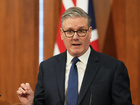
Almost three dozen countries will meet Thursday in an effort to exert diplomatic and political pressure to reopen the Strait of Hormuz, a vital shipping route that has been choked off by the U.S.-Israeli war against Iran.
British Prime Minister Keir Starmer said the virtual meeting chaired by Foreign Secretary Yvette Cooper "will assess all viable diplomatic and political measures we can take to restore freedom of navigation, guarantee the safety of trapped ships and seafarers and to resume the movement of vital commodities."
 Full Story
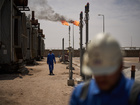
World shares were higher and oil fell briefly below $100 per barrel on Wednesday after U.S. stocks soared to their best day in almost a year on renewed hopes that the Iran war could soon end.
The renewed optimism over a possible de-escalation of the Iran war, which is in its fifth week, came after U.S. President Donald Trump said on Tuesday the United States will be done attacking Iran probably in two to three weeks, and that the U.S. "will not have anything to do with" what happens next in the Strait of Hormuz.
 Full Story
The Russian vessel Anatoly Kolodkin docked Tuesday at the Cuban port of Matanzas laden with 730,000 barrels of oil, marking the first time in three months that an oil tanker reached the island.
The administration of U.S. President Donald Trump had allowed the shipment to proceed despite its ongoing energy blockade.
 Full Story
U.S. President Donald Trump said nations upset by high fuel prices should "go get your own oil" as Iran maintains its chokehold on the Strait of Hormuz.
His comments in a social media post on Tuesday came as average U.S. gas prices shot past $4 a gallon.
 Full Story
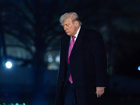
As the Iran war intensifies, President Donald Trump has prioritized efforts to calm the financial markets — trying to keep oil prices from exploding upward, stocks from cratering and interest rates from surging.
When the markets have flashed danger, Trump has been quick with a social media post or a remark to claim the war he launched last month could soon end. He's publicly declared that the markets are doing better than he expected, even with the S&P 500 stock index declining over the past five weeks and the global oil benchmark up roughly 60%.
 Full Story
Europe's inflation rate rose to 2.5% in March, according to official figures released Tuesday, as the Iran war sent fuel prices sharply higher.
The annual rate for the 21 countries using the euro currency compared to 1.9% for February before the war started and blocked supplies of oil and gas from the Persian Gulf.
 Full Story
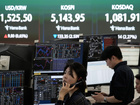
Oil steadied and Asian stocks were mostly lower Tuesday as signs of a de-escalation of the Iran war remained mixed.
Tokyo's Nikkei 225 was down 1.6% to 51,063.72. Losses after the Iran war began on Feb. 28 have been wiping out the gains it made from the beginning of the year.
 Full Story
President Donald Trump on Sunday night said he has "no problem" with a Russian oil tanker off the coast of Cuba delivering relief to the island, which has been brought to its knees by a U.S. oil blockade.
"We have a tanker out there. We don't mind having somebody get a boatload because they need … they have to survive," Trump told reporters as he flew back to Washington.
 Full Story
Paola Fouad Noun, a 25-year-old born and raised in Beirut, moved to San Francisco after completing her university studies in the United States, where she established herself within a specialized team of engineers in Forward Deployed Engineering at Ramp.
She played a foundational role in this field before its widespread expansion and transformation into a primary driver of the industry. At Ramp, which is currently valued at $32 billion, Noun holds a prominent position that has allowed her to witness and adapt to the radical shifts in software development methodologies.
 Full Story


